AI-optimised website design
Your website is invisible to AI.
Patients are asking an AI assistant who to see. It reads the websites it can understand and names two or three of them. Most practice websites look fine to a person and give a machine almost nothing. We build the other kind.
You own it outright Four to eight weeks Healthcare specialists
What a machine reads on a typical clinic site
- Services offered not found
- Practitioners not found
- Locations and hours not found
- Answers to patient questions not found
Illustration. Typical result on a clinic website we are asked to review.
What you actually get
A website built to be the answer, not a brochure.
-
Structured for machines from the first line
Every location, practitioner and service published as structured information an AI assistant can read, rather than left for it to guess from paragraphs.
-
Answers in the format AI quotes
The questions patients actually ask, answered directly on the page, in the shape assistants lift into their answers.
-
Fast on a phone
Pages delivered complete and quick on mobile data, because that is where most patients arrive, and a crawler should never have to guess what is on a page.
-
Booking as the main path
Your existing booking system wired in, the path to it short and obvious, and tested logged out before and after launch.
-
A dashboard that proves it
A live view of which AI assistants name your practice and how often, benchmarked from the day the site goes live.
-
Yours to keep
You own the site, the code and the domain, and you can edit it yourself. No lock-in.
Proof
What happens when a site becomes readable.
Two of these came from restructuring an existing site and one from a full rebuild. The mechanism is the same: give the machine something it can read.
33 → 100
Agentic browsing score, out of 100, after we fixed how the site was built. Before, an AI agent could not use it. Now it can.
One multi-site client. Baseline 13 August 2026, re-verified 21 September 2026.
3 of 3
ChatGPT, Claude and Gemini all recommend him for shoulder surgery on the Sunshine Coast, for a surgeon whose 103-page website we rebuilt.
Read the case study →32 → 2,241
AI crawler visits per month, June to August 2026, once we made the site readable to machines.
Read the case study →Recent builds, live now
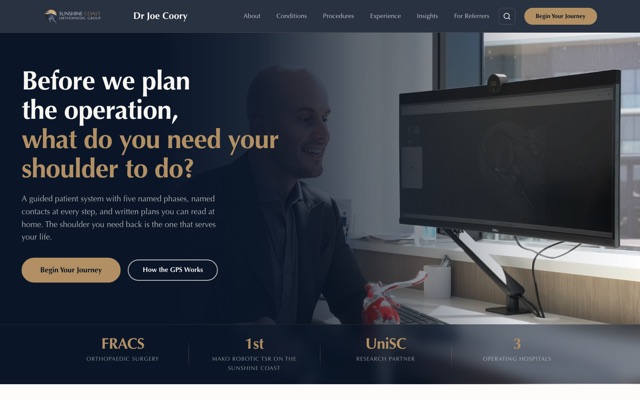
Dr Joe Coory
Orthopaedic surgeon, Sunshine Coast
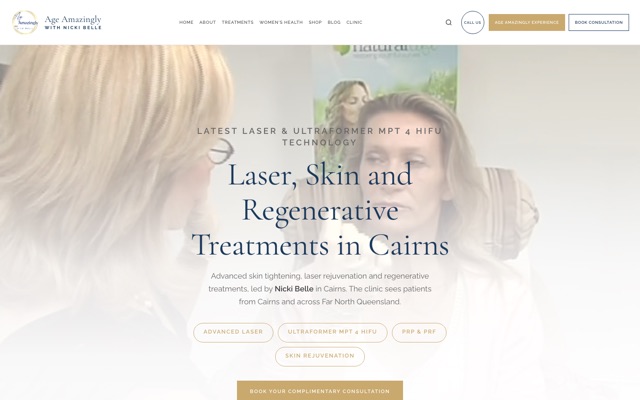
Age Amazingly
Skin and laser clinic, Cairns
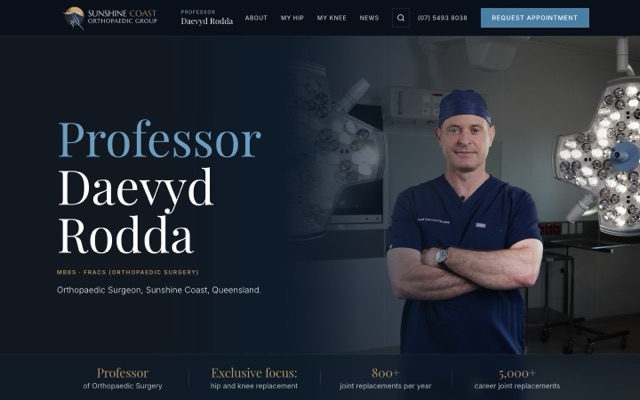
Professor Daevyd Rodda
Hip and knee surgeon, Sunshine Coast
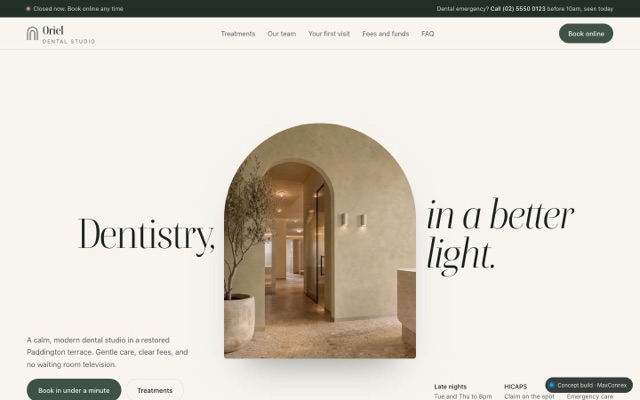
Concept builds
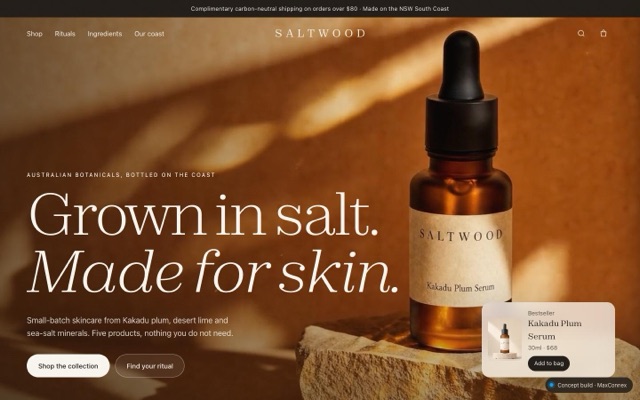
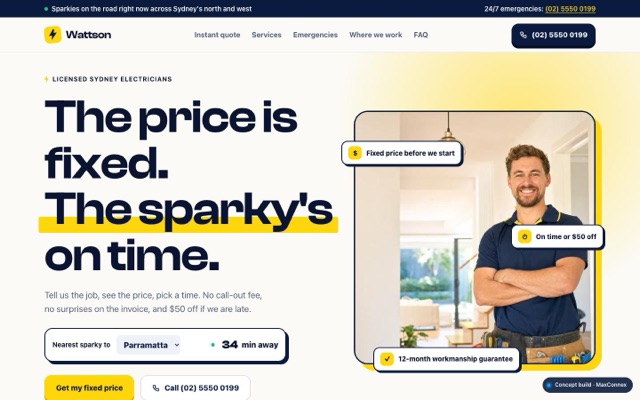
Four fictional businesses we designed and built to show the range, from e-commerce to a local trade. Each one works: open it and try the booking, the cart or the quote.

How it works
Four steps. Four to eight weeks.
-
01
Structure
Sitemap, page hierarchy and the entity model, agreed before any design starts.
-
02
Design
Desktop and mobile, reviewed as real pages in a browser rather than flat images.
-
03
Build and wire
Development, booking integration, tracking, structured data and an accessibility pass.
-
04
Launch safely
Every old URL redirected, and the real booking flow click-tested before and after go-live.
Book a build call
Tell us about the site. Then pick a time.
Thirty minutes with Maxwell. We look at your current site together, what AI assistants can and cannot read on it, and what a rebuild would involve for your practice and your budget.
- No obligation, and no hard sell.
- If a refresh is enough, we will say so.
- Healthcare and a small number of other businesses.
Answers
Website build questions
How much does a new practice website cost?
It depends on the number of pages, locations and practitioners, and what the site has to connect to. Rather than publish a price that fits nobody exactly, we ask for your budget range in the brief below, so on the first call we can tell you plainly what fits it and what does not.
How long does a practice website take?
Four to eight weeks for a single-location practice, longer for multi-site groups or anything with a practitioner directory. The variable is almost never development. It is how quickly content, photography and approvals come back.
Will a new website hurt our existing search rankings?
It can, and that is the single biggest risk in any rebuild. Rankings are lost when old URLs return a 404 instead of redirecting. We map every existing URL to its new home before launch and verify every one afterwards. Done properly a migration is neutral to positive.
Do we have to change our booking system?
No. We integrate with what you already use, whether that is HotDoc, HealthEngine, Cliniko or a form. Changing booking platforms during a rebuild means two risky changes at once on the one path you cannot afford to break.
Do I actually need a new website, or just a refresh?
Sometimes a refresh is enough, and we will tell you if so. If an AI assistant cannot identify your services, practitioners and locations from your current site, a rebuild is usually the faster and cheaper fix than working around it. The free check scores your site in about thirty seconds.
Who owns the website afterwards?
You do, outright, including the code and the domain. Hosting and ongoing care are available but not compulsory, and there is no lock-in that makes leaving expensive.